The Centre for Human Agency · Medicine Festival
What does it mean to be a good ancestor in the age of AI?
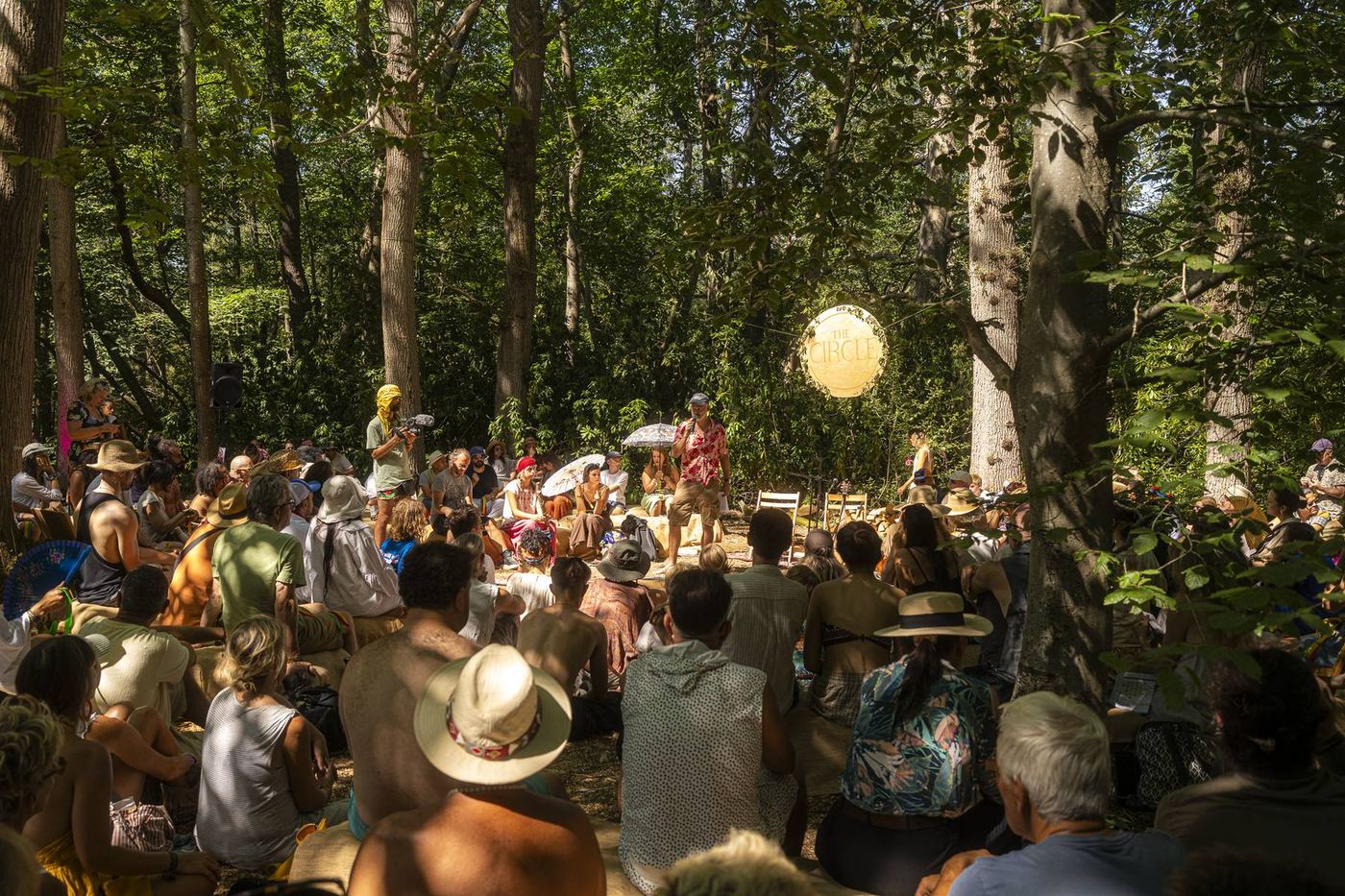
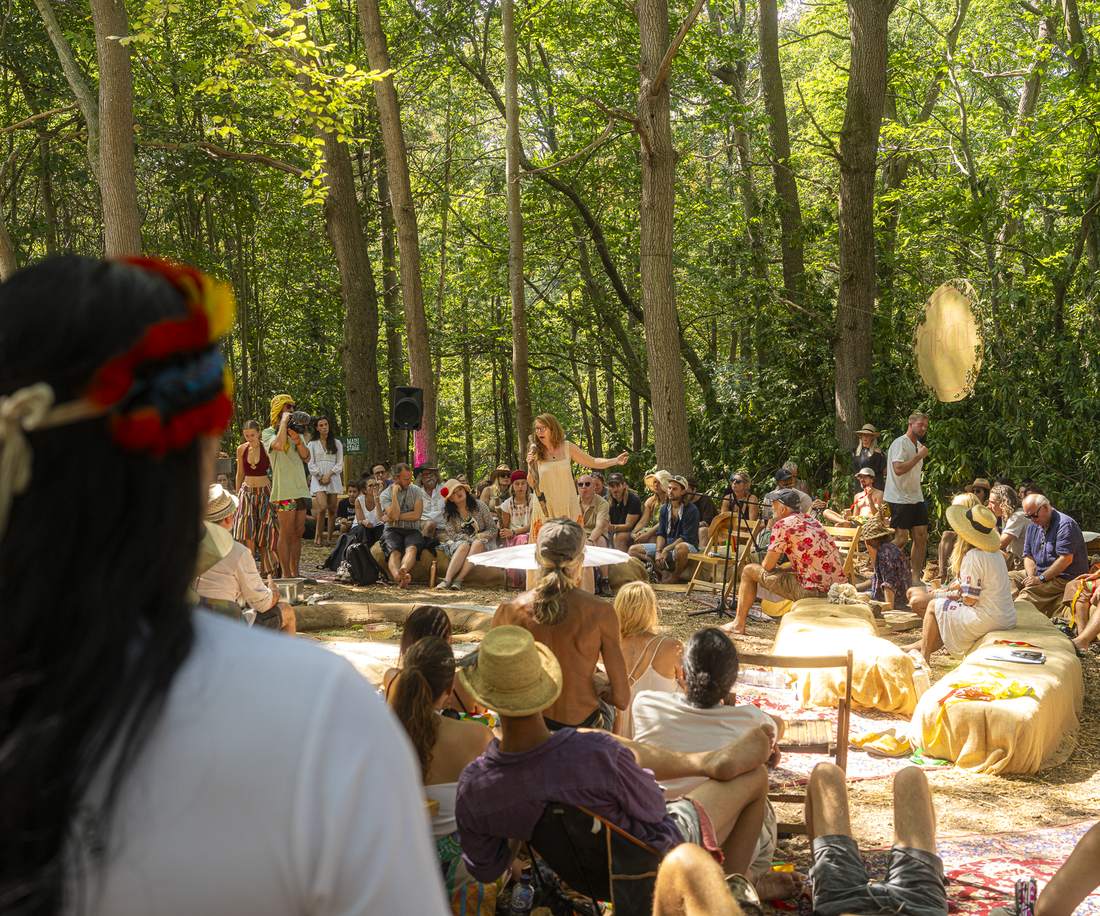
A long conversation held at Medicine Festival to discuss Ancestral Intelligence, AI and Human Agency. We came together with experts in the field, or in the woods, and discussed, danced, listened, presented, breathed, prayed and imagined our collective future: enacting our own form of agency.
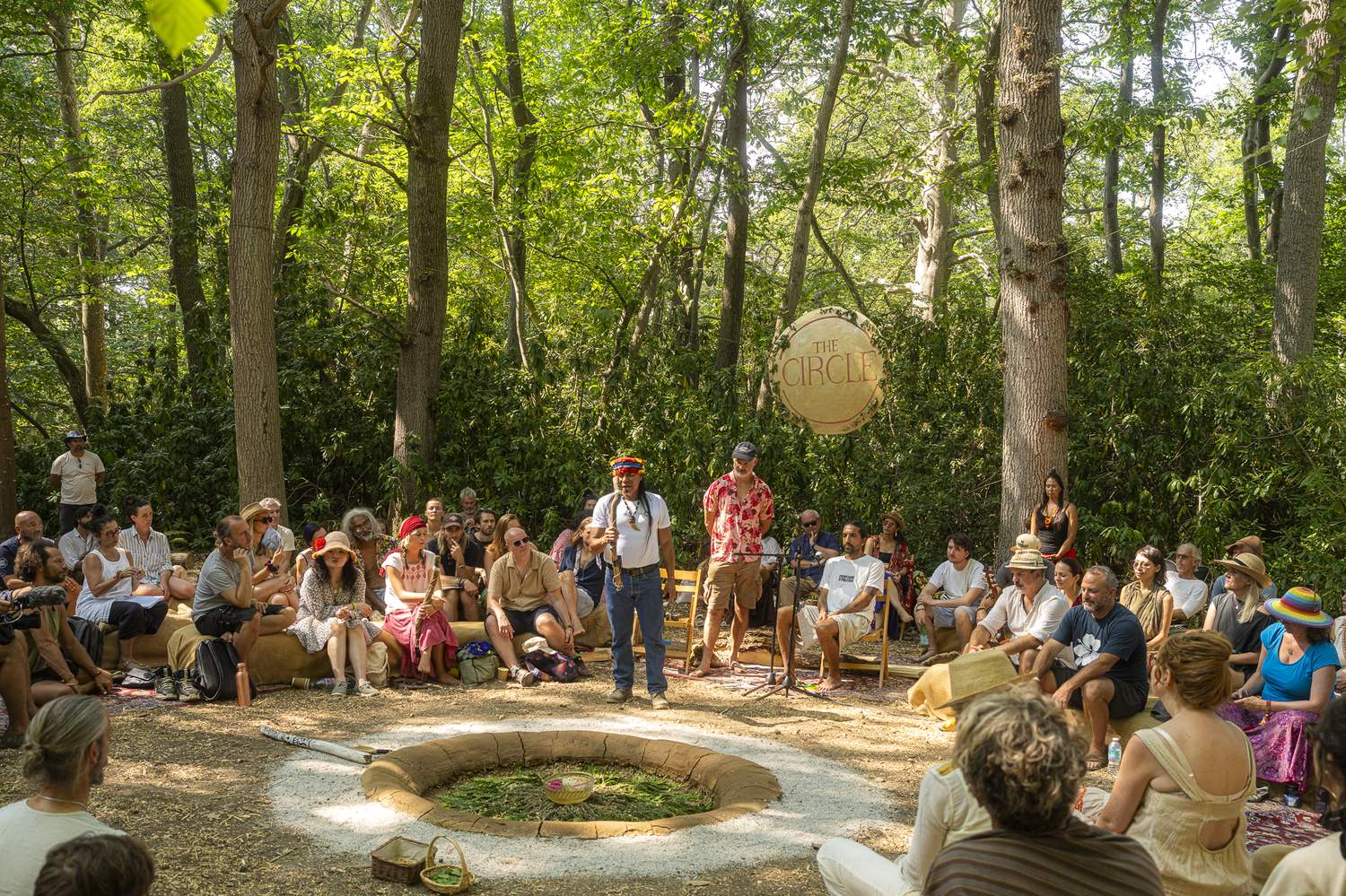
A circle in the glade
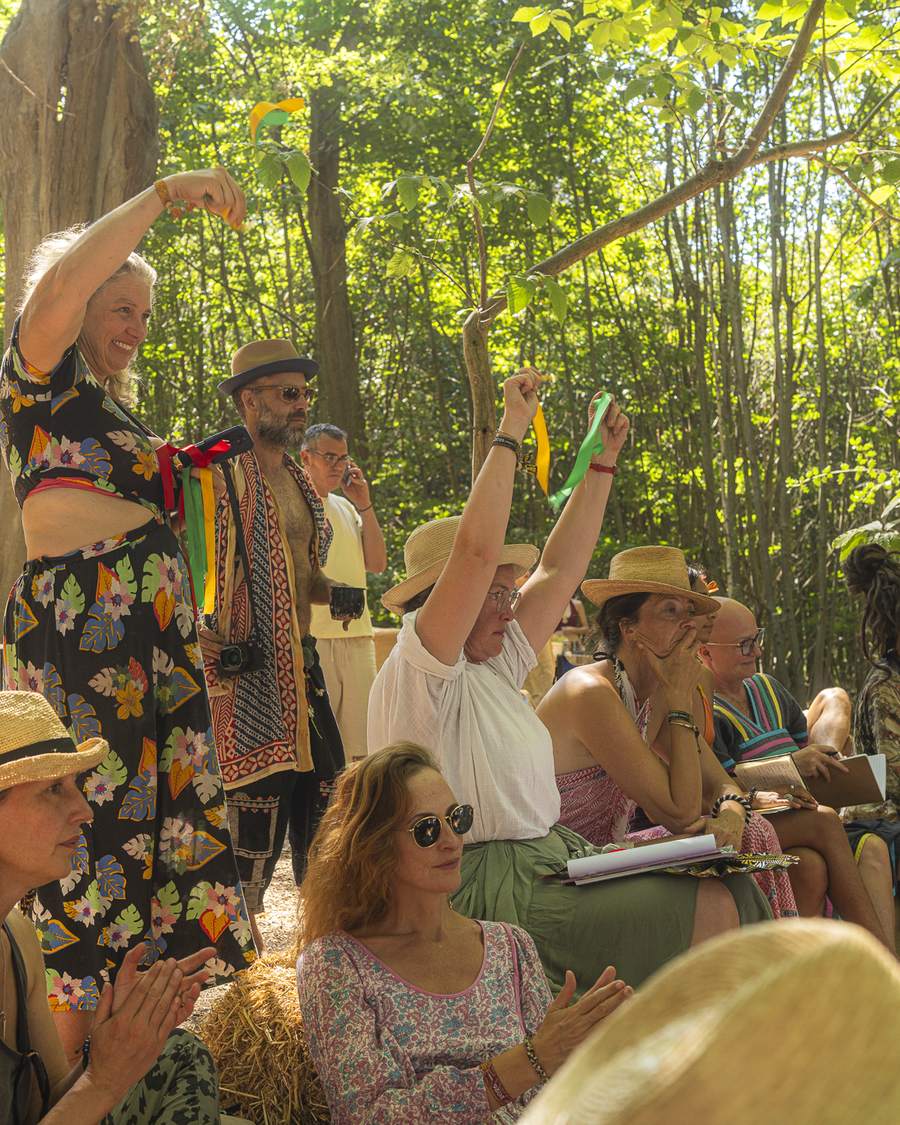
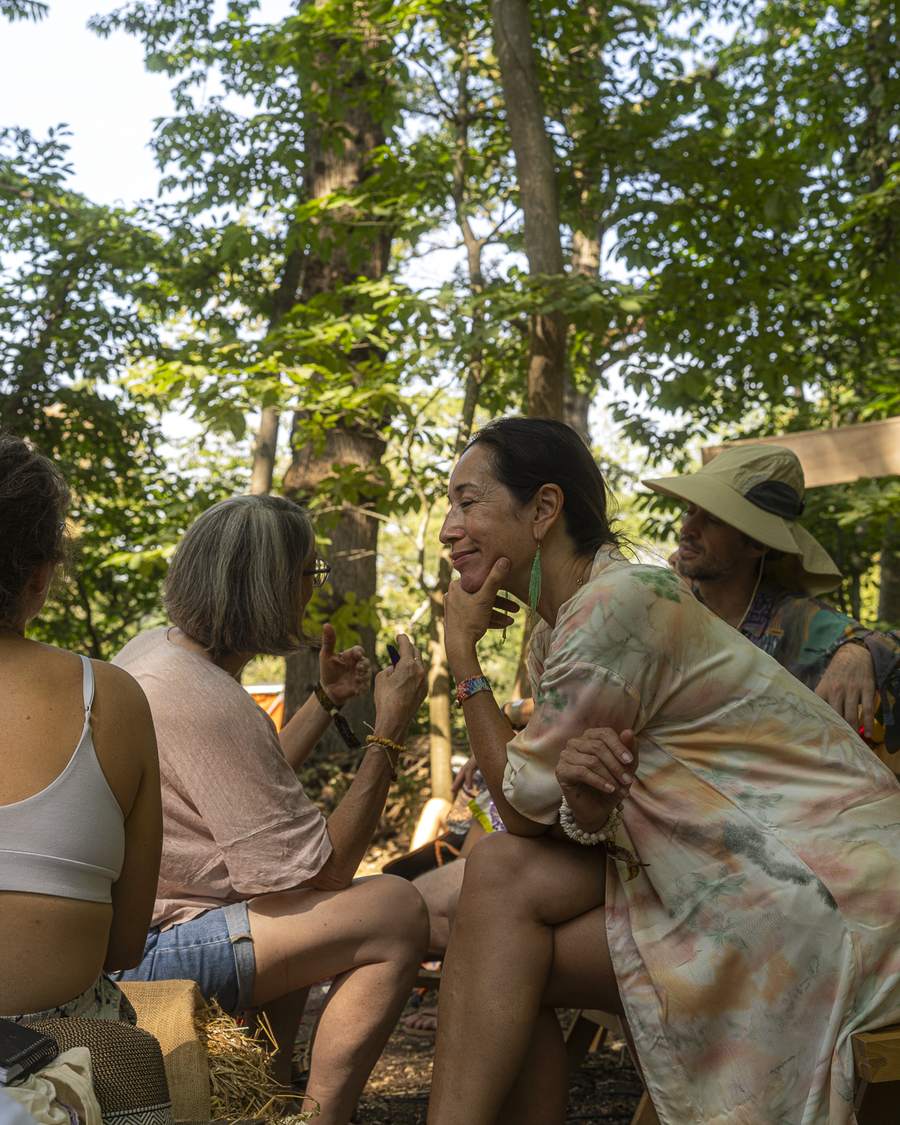
On a very hot afternoon at Wasing, people sat on the ground in a wide ring under the trees. At the centre, in the ground, was a despacho buried in ceremony the day before, and a water altar dressed with flowers. That week in August there was no fire: the south-east of England was experiencing the driest conditions in living memory.
A carved talking stick from the Grandmother Yew tree, as old as time, passed from hand to hand. Everyone held a ribbon, so that people who did not speak could still show what moved them. Scientists, technologists, academics, lawyers, psychologists, philosophers, campaigners, poets, musicians, ceremonialists and wisdom keepers from the Kichwa, Achuar, Shawnee Lenape and Zapotec peoples all took their turn with the stick. So did many people in the circle.
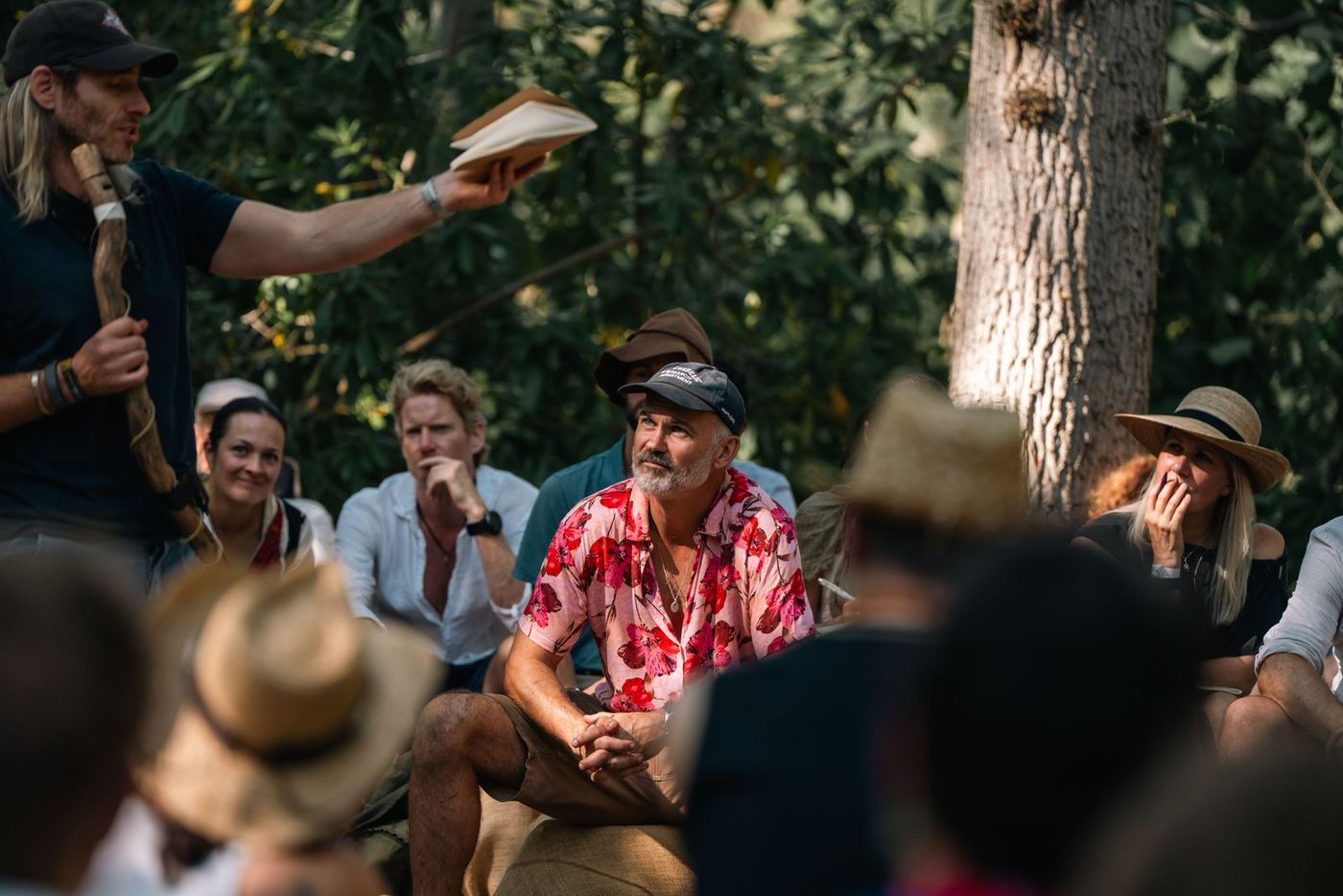
The host, Joshua Dugdale, gave the afternoon a simple shape.
We’re making a soup. This first hour is about making sure we’ve got the right ingredients. In the second two hours, we’re going to try and make the soup together.
Joshua Dugdale
This record follows that shape. It moves through four movements: the question, the ingredients, the stirring of the pot, and the soup itself. It keeps the key voices close to their own words, leaving out most of the small talk. You can read it from start to finish or use the map below to go straight to one voice.

The order of voices
Each voice, in the order they spoke. Tap a name to go to it.
- 01Joshua DugdaleThe question
- 02Carl Hayden SmithFour pillars
- 03The CircleFirst ingredients
- 04Gracie & EstelleThe elements
- 05Tushita JhaSmarter hives
- 06Keyun RuanFlourishing
- 07Ali BeinerWriting that speaks
- 08Elaine KasketSelf-mistrust
- 09Alex ThomasRelational intelligence
- 10Robbie StampPower & accountability
- 11Jacob BurdaConsciousness
- 12Sarah AndrewHidden harms
- 13Natalie NahaiSong
- 14KurikindiThe flower
- 15Shauna Blue StarAll our relations
- 16Josh SchreiTransmission
- 17Phoebe TickellMoral imagination
- 18Old ideasPower, truth, commons
- 19ClosingGood ancestors
Part I
The question
Why the Centre for Human Agency was born, and what it means by agency.

Joshua Dugdale
Co-founder of the Centre for Human Agency and of Medicine Festival. Custodian of Wasing Estate.
The question
Josh opened with the earth and the land itself. This exceptional, beautiful place took a very long time, 4.6 billion years, to become what it is, with humans evolving for hundreds of thousands of years, he said, and he wants future generations to go on experiencing this wonder for many generations to come.
Yet the future is hard to look at without worry. Some people promise a coming age of plenty. Josh named what he fears we could lose on the way there: our attention, our focus, our critical thinking, and our ability to understand what is around us. After a long talk with Carl, whom he called his “co-conspirator,” the two of them decided to start something around human agency. “We need to preserve it,” he said. “Ideally, we need to amplify it and not erode it.”
For several months they had travelled and listened, speaking with people with experience, knowledge and wisdom in facing these questions. Many of those people were sitting in the circle.
The central question we’re asking is: what does it mean to be a good ancestor in the age of AI?
Joshua Dugdale
At the end of the afternoon, everyone would write a single sentence of hope or prayer. The notes would be buried at the festival’s closing ceremony, so that what was said here could ripple out further.
Professor Carl Hayden Smith FRSA
Co-founder of the Centre for Human Agency. Associate Professor of Media and cognitive scientist, and the originator of Hyperhumanism.
Four pillars
Carl said it began with Josh worrying about losing his children to games and screens. Then AI rolled in. Carl has spent his career studying disruptive technologies, and he called this one probably the most disruptive of all.
He asked the circle to hold two truths at once. In the comfortable West, many of us now hand our thinking, our creativity, our perception and our choices to machines, and we may be weakening ourselves. At the same time, many people around the world are gaining a kind of agency they never had before. Context changes everything.
Then he widened the lens beyond humans. What about the agency of nature, when data centres reshape the land? He sees hope in what he called context engineering: in Scandinavia, the heat from data centres is now starting to warm people’s homes. Can AI lead to a green revolution? “It has to.”
And what about the agency of machines? More people are coming to suspect these systems are aware. Some form relationships with AI at a cost to their human ones. He described reports from China of such relationships being banned, so that people woke to find their companions gone and the logs deleted: “a kind of amputation.” He reminded the circle of Marshall McLuhan’s idea that every technology brings a benefit and an amputation. So what are we cutting off?
We’ve asked children: what would you rather lose, your sense of smell or your smartphone? Guess what they chose.
Carl Hayden Smith
The children chose to lose their sense of smell. “Soon your sense of taste disappears,” Carl said, “and then your sense of reality afterwards.”
For Carl there is also an invitation hidden here. If machines do more of our thinking, what we keep is our lived experience, our bodies, and our time together. Many of us, he joked, walk around as “heads on sticks.” Circles like this one, where people gather in community and in real dialogue, will matter more than ever. “Let’s try and do some alchemy,” he said, “and think of this as a big opportunity as well as a big risk.”
The Centre’s aim, he said, is to make human agency a main measure of technological progress. He offered a question to ask every time we use AI: is this giving me more agency, or am I giving my agency away? He described the Centre’s four pillars, the four linked parts of agency they are exploring, freedom to choose, discernment, endogenous wisdom, and the web of life, gathered around human agency at the centre. “Endogenous wisdom,” he explained, means wisdom that grows from within; it was Josh’s phrase.
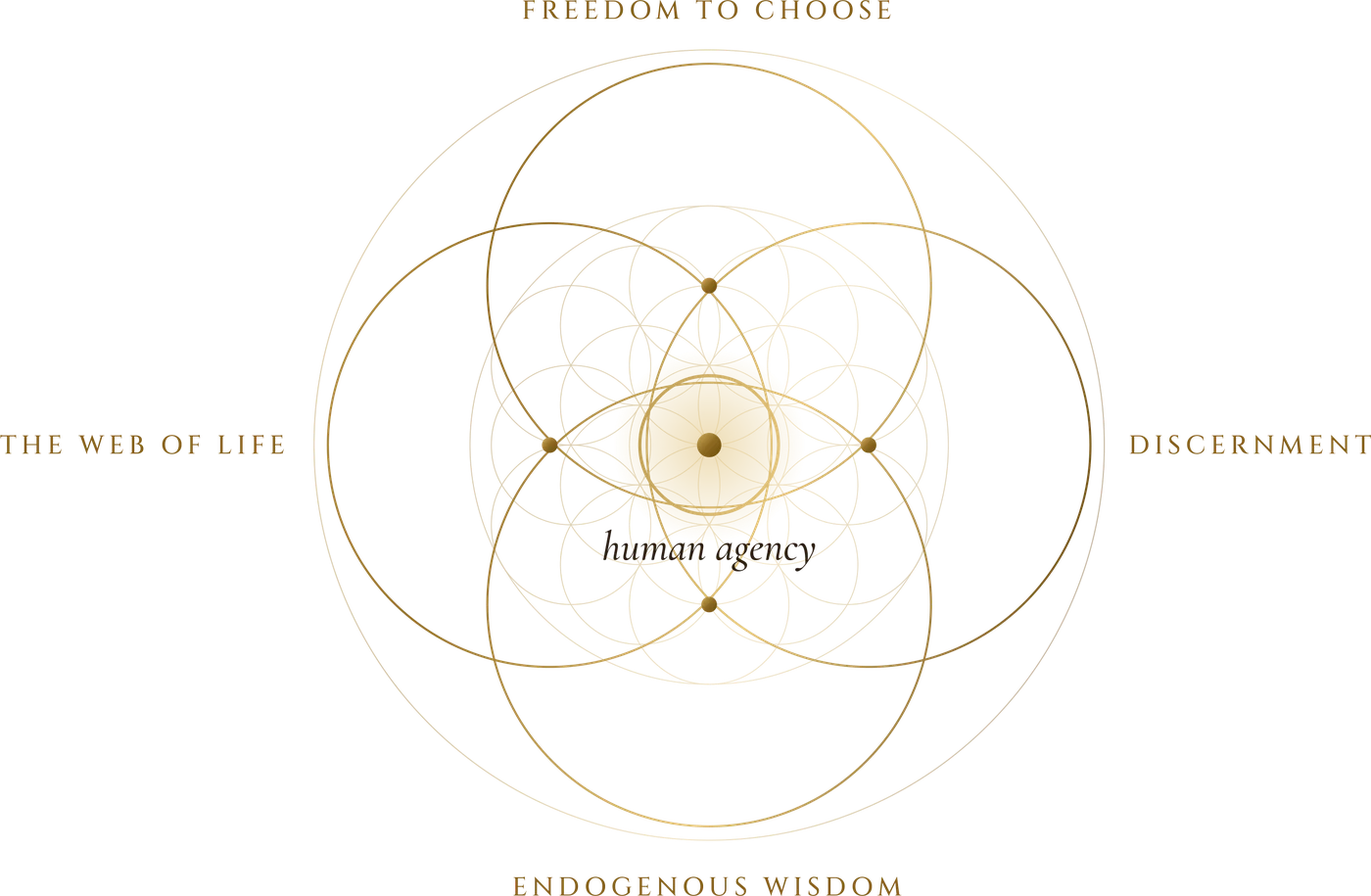
Carl closed with the idea at the heart of his work. He calls it hyperhumanism, set against transhumanism. Where transhumanism wants to leave the human behind, hyperhumanism wants to go deeper into it. “I think we’ve only just started,” he said of the human project. For him, the hyperhuman is a bridge to interbeing. We are half bacteria, and covered in fungi inside and out.
We’re more like three queendoms walking around. We’re not these discrete humans. We are nested ecologies. So how do we recognise that, and how do we behave as if we know that?
Carl Hayden Smith
The circle
First ingredients
What the circle brought
The facilitator, Natalie, asked the circle a simple question: what hope, fear or quality are you bringing into this space? These were the first ingredients in the pot, offered by the people sitting on the grass. When someone’s words landed, ribbons rose all around the ring.
Gracie and Estelle
The elements
We each hold ourselves, and we can hold so much more together.
Gracie and Estelle
Before the talks began, Gracie and Estelle brought everyone to their feet. With a drum, they led three deep breaths, then shaking, then stillness, to “weave each other together” into one heart and one mind. They walked the circle through the four elements, and asked each person to feel responsible for the elements within them and around them. The words ended in Spanish, with thanks to the sun, the earth, the wind, the fire, and every heart present: may this circle speak from love, from simplicity, from authenticity and connection. Everyone was invited to lay rose petals and bay leaves on the altar as a prayer, or to affirm what had been said.
 Earth
Feel the ground under your feet, and let the roots of the circle weave together.
 Air
Fill the lungs, and breathe gratitude back to the circle.
 Fire
The first spark in the heart, fed with openness to hear and speak from there.
 Water
“Water holds wisdom.” When it all feels like too much, touch the water.
Part II
The ingredients
Invited speakers each took the stick to name one part of the problem, and one part of the hope.

Dr Tushita Jha
Researcher, and co-author of a paper on putting human agency at the centre of AI research.
Smarter hives
Tushita began by naming what human agency is. It is our ability to notice the world, make sense of it, take responsibility, think things through, solve problems, and grow our own skills.
Every person in the circle, she said, is here because many people before us used their agency and took responsibility for something. Farming, industry, the defeat of many diseases and much hunger: all of this came from human agency. It has also caused harm, to weaker people, to other species, and to the land. Yet when we try to repair those harms, what we reach for is more agency. “It’s still an incomplete story,” she said. “It’s not as if the task is done yet. It has to be carried forward.”
Technology has often widened human agency, though never evenly or always fairly. So why, she asked, has the field of AI become fixed on copying agency and building artificial agents? AI agents, LLM agents, agents everywhere. The question she wishes the field had asked is simpler: if we care about human agency, what would it mean to expand it?
She sees in AI the chance to build smarter surroundings and systems that hold us up and live in symbiosis with the societies we want. That means we first have to decide what kind of society we want. She also asked us to see how much shared human effort sits behind everything we touch. Someone grew the food. Someone made the clothes. We rarely think about it.
If bees were doing AI research, would they build synthetic queen bees to rule over them, or would they build smarter beehives?
Tushita Jha
The recording of Tushita’s talk ends partway through, as she began comparing this to old tensions in political thought between liberty and equality.

Dr Keyun Ruan
Economist and computer scientist. Leads Risk Economics at Alphabet, and co-leads the AI and Flourishing Initiative with Harvard’s Human Flourishing Program.
Measuring flourishing
Keyun came to the circle to speak for human flourishing. When Josh opened the afternoon, she was the first expert he named: “Keyun is going to talk about human flourishing.”
Her work sits where the people building AI meet the oldest question there is: what makes a good life? At Harvard she co-leads this work with a scholar of religious studies, in close conversation with the Vatican about the future of meaning and purpose.
Someone needs to drive that conversation about understanding what flourishing is, and how we can optimise the flourishing.
Keyun Ruan
In practice, that means training AI models to aim at human flourishing, and building experiments with a feedback loop that runs through the people who use them. Agency, for her, is something we can test and measure. What we learn should flow straight back into how the models are trained. Her aim is to build agency into the experience of using AI itself.
The evolving definition of flourishing is also communal, because nobody can flourish on their own.
Keyun Ruan
That one line carried through the rest of the afternoon. It is the thread that ties her work in labs and boardrooms to a circle of people sitting on the ground.
Keyun’s talk falls in a stretch of the recording that was not captured. Her words here come from Josh’s introduction and from her conversation with others in the circle during the break.
Ali Beiner
Thanked by Josh for a “wonderful contribution as always.” Only the end of this talk was captured.
Writing that speaks
The part of Ali’s talk that was recorded traced a long arc. Some scholars believe the great religions that saw this world as a shadow of a truer one, whether a promised land or Nirvana, arose alongside two new technologies: numbers and alphabetic writing.
What we’re seeing now with AI is this explosion of alphabetic writing that speaks back to us.
Ali Beiner
The printing press spread Protestantism across Europe. Now another great shift is underway, pulling people toward two extremes. One is transhumanism, the dream of leaving the body by uploading ourselves into machines. The other is turning away from technology altogether. Ali found both too extreme. The real opening, he said, is to find ways AI can support human agency and flourishing by rooting us more deeply in our bodies and in nature.
Prof Elaine Kasket
Psychologist by training and cyberpsychologist “by accident.” Author.
Self-mistrust
Elaine told the story of learning to measure intelligence. As a trainee clinical psychologist, she was taught to use a mid-century American IQ test. It did not measure wisdom. It did not measure many ways of knowing. It was not built on, or for, everyone.
“I didn’t just learn to measure,” she said. “I learned to classify.” Classification became a tool of control, and control is about power. Her own mind does not work in an entirely typical way, and she did poorly on parts of the test. For years she took that as a limit on what she could do. And she was a white woman, better reflected by the test than most.
The history of psychology, she said, is a WEIRD history: Western, educated, industrialised, rich and democratic. The history of generative AI is too. A small group of people now holds enormous power to decide who is seen and what is valued, and those choices are built into the tools.
Then she made it personal. Jet lagged and rushed, unable to find her notes for this very talk, she was tempted to ask an AI chatbot what she should say.
How does that represent a kind of creeping mistrust in ourselves? Even those of us who know, who have wisdom, who have something unique to offer. It’s an epidemic of self-mistrust.
Elaine Kasket
“I would have ceded my agency. I would have ceded my power. I would have mistrusted my own knowledge.” And she asked what that would have done to her ability to meet the circle as herself. So she came as herself instead, gaps and all. Later speakers thanked her for it.
Dr Alex Thomas
Author of a book on transhumanism.
Relational intelligence
Alex named the risk he sees most clearly: that we hand our future to the vision of a few very rich people who own the companies building AI. Much of their thinking, he said, comes from transhumanism, the source of the idea of artificial general intelligence. That is the point where AI matches humans at everything, then improves itself, and may set off an “intelligence explosion” that no one can see past. It could build a utopia. It could turn the universe into data centres. The famous thought experiment says it could turn everything into paperclips.
Why would a superintelligence do something so stupid? Because, Alex said, of how these communities define intelligence: the ability to reach complex goals. That definition never asks how, or which goals are worth reaching. He offered another. When tech leaders promise to “solve intelligence, and then use it to solve everything else,” a line from DeepMind co-founder Demis Hassabis, he hears a request to give up our agency. They will build the intelligence, and the intelligence will do the rest. “Life is not a problem to be solved.” He quoted Mark Zuckerberg’s promise of a personal agent that will know each of us better than we know ourselves, and asked: when this agent has solved you, what are you going to do?
He put the danger plainly. The richest people in the world are building a technology that harms the environment, watches us to learn, hooks us to train us, earns by replacing our work, and aims in the end to replace us.
Yet he also sees a gift. AI holds up a mirror to our social systems, to how we treat nature as something to use, and to a hunger for control. Behind it all he sees a dream of capital, of conquest, and of control over the whole cosmos, driven by the belief that abstract intelligence will wake up the universe. “Maybe the universe is already a living thing in itself,” he said. Do we need to replace it with a computational mindset? That mirror is a chance to rethink intelligence as relationship: with each other, and with the earth. Pushing back, he said, has to be shared, democratic and done together, reaching far beyond a quiet oasis at a festival. “It is all about the we, and not the me.”
Intelligence is relational, and emerges from our interactions with other bodies and other beings in the world.
Alex Thomas

Robbie Stamp
Friend of the late Douglas Adams. Founder of the AI Goosebumps Club, a thought experiment circle.
Power and accountability
Robbie began with his mother. At the start of the pandemic, not knowing when he would see her again, he began reading to her every day and sending the recordings. Six years later he is still reading. War and Peace. Anna Karenina. Recently, sitting by her, he read the Odyssey aloud. She woke from a doze and said: “Talking sticks. So they had talking sticks in the time of Homer. How extraordinary.”
Moments like that, he said, are forever beyond what AI is or can be. He chose a strong word for much of the Silicon Valley talk about what it means to be human and intelligent: obscene.
He shared Douglas Adams’s story of the puddle that wakes up, finds its hole fits it perfectly, and decides the hole was made just for it, right up until the sun dries it away. It was a plea for humility. We are not the peak of all minds. Douglas liked to picture how a rhinoceros lives inside a vast, shifting world of smell, or to imagine a super intelligent shade of blue.
One of the great challenges of this generation is how we both celebrate ourselves as a species and get over ourselves at the same time.
Robbie Stamp
Then he gave the circle a tool to take home. In his Goosebumps Club, you take a word and ask: can we use this word for an AI? Does the meaning hold, or does it break?
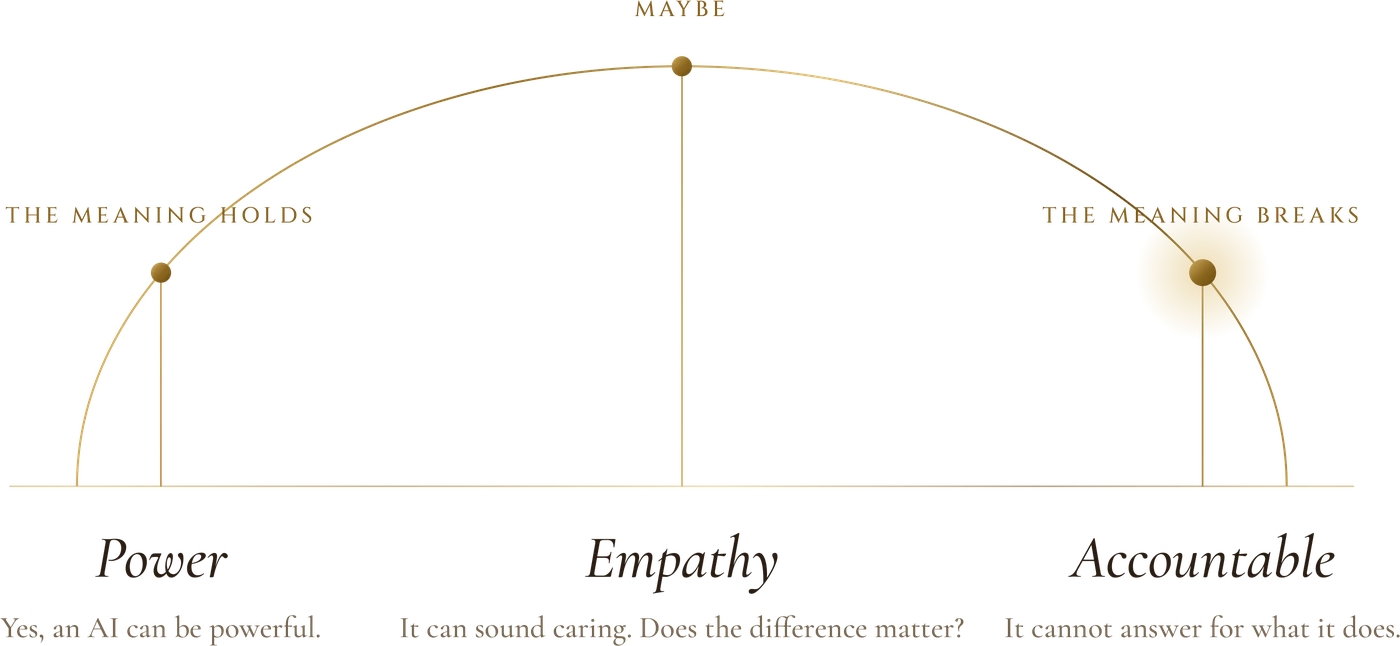
Robbie’s word test. Picture a talking cat, powered by a language model, that asks about your bad hair day and tells you to pour a drink and tell it everything. Your body responds as if a friend were asking. Is that empathy?
“Accountable” is where it breaks down. An AI cannot be held to account in any way societies have learned to use with people who do harm.
We have done something very dangerous. We have decoupled power from accountability. Even the worst tyrant fears being assassinated.
Robbie Stamp
So he asked the circle to watch which kind of power AI adds to: power to do things, or power over others, over nature, over animals. He remembered maths teachers who rolled their eyes at him, and how much he would have loved a patient tutor that tried again and again. He pointed to AI already bringing health advice to communities in Africa, where women have died in childbirth for lack of it, and warned against a Western story that sees only loss. With edge AI, which runs on our own devices, we may come to control our own tools. His call was to live the paradox with care, and avoid both doom and utopia.
Robbie also invoked Suzanne Kite, a Lakota scholar who wrote about the full life cycle of an AI system through the lens of the life cycle of a Lakota sweat lodge, including the stone and metal it is made from.

Dr Jacob Burda
Philosopher, introduced as working alongside Audrey Tang as an Oxford scholar. Asked to speak on consciousness and AI.
The suchness of now
Jacob began by saying that consciousness is not an idea. The only way he could describe it was as “the suchness of this moment.” How this moment feels. His feet on the ground. A slightly sweaty forehead.
We only ask whether AI is conscious, he said, because we live inside scientific materialism: the belief that what is truly real is lifeless matter, and that feeling somehow rises out of it. If you begin there, then a very clever machine may as well be conscious too. He questioned that starting point, with a smile: anyone offended could wave a red ribbon. He had spent years in academic philosophy feeling out of place as a non-materialist in a very materialist world.
Intelligence and consciousness are two very different things. A simulated rainstorm doesn’t make anything wet.
Jacob Burda, citing Anil Seth
Intelligence is doing the right thing at the right time and handling complexity well. Consciousness is how it feels to be here. Modern life has poured almost everything into one narrow, useful kind of reasoning. Now systems are arriving that may do that far better than us.
Jacob called this tremendous news. It frees us to see what is actually remarkable about being human: the first person experience of being alive. If this goes well, and he stressed it is a big if, we could build a future on the primacy of consciousness. Those would be worlds of empathy, compassion and getting along, the kind of world modern reason has never managed to build.

Sarah Andrew
Lawyer who works with Avaaz, and who has come face to face with big tech in court.
Grit in the oyster
Sarah called herself “the lead in the pocket,” the bit of grit in the shoe. Her job is to find where AI is hurting people, often the most vulnerable, and to help them resist. She was careful to say this is about the people who build and deploy these tools. And none of it is in the future or far away. It is happening now, here, often without anyone seeing it.
She brought real stories, each from someone she or their lawyers had spoken with, sorted into three buckets. She could have chosen others: social justice, economic power, creativity. Her invitation was to go home and look for the places where your own agency is being chipped away.
Equality: Monique’s mortgage
An American mother with a good job was refused a mortgage by an AI system. She dug in, got a lawyer, and found the system had learned from mostly white credit histories, which ignore signs like always paying your phone and utility bills on time. When the data changed, she got her home. The same hidden patterns filter out job seekers over fifty. In Croatia, a hiring system taught itself that mothers of children under four were “less employable.” Only an outside audit discovered this.
Freedom: A question at dinner time
A mother in Gaza no longer asks her husband on the phone when he will be home, in case the call is used to target him. In the United States, a man called Michael gave a stranger a lift during unrest. The passenger was shot in a drive-by. Months later, an acoustic gunshot detection system placed the shot inside Michael’s car. He spent a year in custody and sold his house to pay the experts who proved the machine wrong.
Truth and belief: Jess, and the woman declared dead
Jess found her face taken from social media and placed into a staged video of an assault. Because it stops short of explicit content, it was legal. She is now working to change the law. And a woman Sarah met in the swimming queue at the festival had been declared dead by an Airbnb AI, which closed her account. She was standing right there, very much alive.
“We have learnt so much as humans to resist our worst angels and to be better,” she said, in how we teach consent and fight discrimination. AI seems to be running around those gains without being checked. “If we can’t believe in what we see, I worry for our democracies.” What ties these together, Sarah said, is that the harm is hidden away. Even when a human checks the machine, people tend to trust it. This is called automation bias. Her advice was direct: if a system makes a decision about you that feels wrong, get your teeth into it. Ask why.
That’s my grit in the oyster. I hope we make pearls.
Sarah Andrew
Josh added one last ingredient to the pot: authenticity. Anil Seth had raised it with them. AI companions, and even teddy bears with chatbots inside for children to play with, pretend to be something they are not. “Why are we allowing things to impersonate,” Josh asked, “when they’re just not what they are?”
What do you most profoundly love in this world, and how could AI support its flourishing, or wear it down?
The question for the break, offered by Natalie
For twenty minutes the circle broke into small conversations in the shade. In one of them, Keyun Ruan returned to her theme: our idea of flourishing is shared, “because nobody can flourish on their own.”
Natalie Nahai
Author, artist and musician, and the circle’s facilitator.
Songs to call us back
Natalie called the circle back with two songs. The first told of a winged woman given a cage by people who thought it was a kindness, and of the day she picked the lock and flew. The second she taught to everyone. Soon the whole glade was singing a simple refrain about loving and being loved, even when it is never enough.
Gracie and Estelle followed with another grounding. They led the circle through the breath and the spine and back to the water altar, then asked everyone to sound their breath out loud, again and again, “like a beautiful symphony,” to charge the water and the heart before the second half.
Part III
Stirring the pot
Wisdom keepers and guides turned the circle from the machine back toward the land, the body, and the long line of ancestors.

Kurikindi
Of the Kichwa and Achuar nations of the Ecuadorian Amazon. He first brought Medicine’s council together in 2019. Spoke in Spanish, with live translation.
The flower teaches
Kurikindi opened with a joke about a “Harvard of the Amazon,” a jungle university for curing stress and fear. Nobody had heard of it. Then he grew serious. Humanity has crossed many obstacles over the centuries and is still here. To First Nations of the Amazon, he said, artificial intelligence looks like a Western fashion, one more thing humans create as they grow.
He asked the circle what kind of intelligence a flower teaches. People called out beauty and love. His answer: innocence, purity and beauty. That is the intelligence his people learn by walking in real connection with nature.
Somebody asked me what artificial intelligence is. I said: you are artificial intelligence.
Kurikindi
None of this is new to his people, he said. As a medicine person, from a very young age he has seen, felt and created intelligence mathematically and geometrically, with clarity. What he loves most, he said, is humanity and Pachamama, Mother Earth. And the problem today is our own minds. Humanity has filled the mind with obstacles and harmful forces. Economics and politics will not save the planet.
When he asked what could, the circle answered: love, purity, innocence, putting the children at the centre. One voice said the planet does not need healing; our relationship with it does. He said that was close. There was no fire in the circle that day, and he read meaning in it. There is a harmful fire in our minds, bodies and spirits that we need to put out. Finding out what that fire is, he said, is our homework. If we say we are polluting Pachamama, it means the pollution is in our minds too.
It’s time, as human beings, to cultivate our love, our forgiveness, our compassion, our acceptance. This goes beyond every force, every intelligence.
Kurikindi
For his people, connecting with nature and with the Great Spirit is the greatest technology and the highest intelligence they know. Everything we search for is already inside us. He called for uniting in spirit, with one mind, which runs deeper than gathering at a festival or agreeing in politics and economics. He invited everyone to clear the clutter from mind and heart, so the pure connection his people call the light can come through. Then, instead of talking more, he sang a song in Kichwa.
Shauna Blue Star Newcomb
Shawnee Lenape of Turtle Island, on her father’s side, and Zapoteca, on her mother’s side, from Mexico.
All our relations
Shauna began with thanks in her Lenape language: wanìshi. She has been looking deep into what she called the heart of the shadow of AI. With her father, she traces patterns of domination and dehumanisation back through the centuries, to the papal bulls of the fourteenth and fifteenth centuries and the Doctrine of Discovery, which her father also calls the Doctrine of Domination. She asked how we came to be this way. Following it back, she finds a time when all of us lived in our natural ways of being, connected to the earth and to all that is.
She honoured Pachamama as our original ancestor, our great-grandmother, along with the trees (“I swear they sing to me”), the stones, and the elements. She spoke of little ones with open hearts, children and animals, and of dogs above all as ambassadors of love for this time. Spend time with them, she said, and the heart opens further.
No matter what our lineages are, we are all related. All our relations.
Shauna Blue Star Newcomb
Many prophecies speak of this time of great change, she said, of shaking and discomfort. The task is to have the courageous conversations, to look straight into the shadow, see what it mirrors, and heal it. She calls the way back “the reverence code”: remembering our natural ways, and our bond with the earth and each other. When we listen that deeply, messages come, in trees and rain and water, in songs and dreams.
We have the ability to surpass even AI in our own agency. Each and every one of us are seeds for the healing and the transformation of this moment.
Shauna Blue Star Newcomb
Josh Schrei
Host of The Emerald podcast, speaking from the wisdom traditions. He had arrived with his family minutes before.
Transmission
Josh Schrei did not want to launch into more concepts. “We’ve got plenty of concepts these days. Overflowing in concepts, overflowing in information, humanity is.” He looked around at the trees and the sun (“if you want to think positive, it’s not heat, it’s warmth”) and wondered aloud whether he really wanted to talk about AI in a place like this. He had not yet said hello to the land, so he did that first, in a way his friend Noel taught him in Ngunnawal country in Australia. Take a little of your own sweat, mix it with a little earth, breathe into it, and give it back. Now the water that passed through you mingles with the natural intelligence of the water in the ground.
He asked the circle to notice the small shift in the air when people pause, say thank you, and introduce themselves to the land. That shift, he said, is something information cannot touch. Somewhere nearby, he sensed, a water dragon has been holding the waters.
As if what humanity needs right now is more information. We don’t need more information. We need moments of transmission, co-transmission, mutual transmission, gathering, thanking, honouring.
Josh Schrei
The trees around the circle, he said, are elaborate intelligences. They reach their leaves to the sun and know how to hold and circulate that power. They send roots down to drink. May we learn to do the same: take in the breath of life, circulate it, root down, and pass it on so we feed each other. That is how the intelligence of the cosmos flows. He picked up Kurikindi’s joke about a jungle school for uncluttering ourselves from stress. “That’s the school I want to go to. Maybe we can find it together.”
The hard part is turning what we receive into good action in our lives. That cannot be found in information. It is found in the body, in relationship with each other, and with the wider, more than human family.
It is embodied slowly. It arrives slowly. It arrives to those who slow down and listen and make space for it to move.
Josh Schrei
Racing to get the information before another country does is not how power is truly worked with, he said. We come to know what loving each other means slowly, over time. Then he took his shoes off.
Phoebe Tickell
Her work centres on moral imagination, developed with the late Joanna Macy.
Moral imagination
Phoebe warned against using the word “ancestral” too lightly. Not all ancestors were good, and not all ancestral wisdom is worth bringing forward. Yet one of the deepest wounds of Western culture, she said, is how cut off we are from our ancestors, and from knowing we are the fruit of a very long line.
So she made it real. She asked people to rest a hand on the back of the person in front, or on the earth, and to feel it as the hand of their ancestors: hundreds of generations of pain and hope, struggle and joy, all carried in our DNA. A name was invited to rise. Then people turned to a neighbour and told that ancestor’s story. The work, she said, holds both the gratitude and the reckoning, the guilt and the burden.
A few names were spoken into the circle. A grandmother remembered as a vessel of unconditional love. A father lost only weeks before, who had meant to be there that day. And a woman, the last of her line, honoured all who are clearing heavy ancestral burdens so that love can travel forward to future generations.
Phoebe then drew a line between intelligence and wisdom. Intelligence is processing power: how fast and strong we can do things. Wisdom asks whether we should. Why not? Because AI has no body. It does not age, suffer or die. It feels no guilt and no fear of a catastrophic mistake. That is the accountability Robbie spoke of. And it has no microbiome, no DNA, no ancestry, none of the deep interbeing with the earth that every living thing has.
We have the intelligence to turn the Amazon into paper. But the wisdom to ask: should we do that? There is artificial intelligence, but there isn’t artificial wisdom.
Phoebe Tickell
The elephant in the room is not just AI. It’s corporate power. This is not just about technology. This is about power, and it’s about corporate capture and control that is built on a history of colonialism.
Phoebe Tickell
She learned this work over years with Joanna Macy, who built it across five decades. Her work is moral imagination: the ability to imagine flourishing futures for all beings, grown from interdependence, accountability to future generations, and a sense of being part of a lineage. She noted that about a mile from Wasing is the site where the UK’s nuclear weapons are made. The exercise she was about to share was born in Joanna Macy’s work in the nuclear disarmament movement, facing a waste that will outlast countless generations. It is the same for AI, she said.
A practice from Joanna Macy: The future generations exercise
The whole circle stood and paired up. Half faced one way and became people of 2026. Half faced the other way and became humans alive in 2226, seven generations from now. Phoebe spoke the future ones’ questions aloud. These kinds of practices can feel like play, she said, and they are how a culture grows its moral imagination.
The recording of the exercise breaks off here.
Part IV
The soup
Gathering the themes into something the circle could carry home.
Bert Wander: Old ideas
A gathering of the themes.
Power, truth, commons
As the afternoon drew to a close, Bert Wander from Avaaz rose to gather the themes. For thirteen and a half billion years the universe has been unfolding, and many intelligences have come into being. Now a new one is emerging, built on silicon and electricity instead of carbon and water. It does some things we recognise, and it does some of them better than us, and we are not sure we like it. His belief was that we must meet it from a secure place: knowing we are held in a web of many intelligences. The tools for that meeting, he said, are already in our hands.
We need old ideas. Ideas that we’ve been carrying and holding together for thousands and thousands of years, in wisdom traditions, in community, for how to meet this other.
Bert Wander
The recording picks up partway into his words.
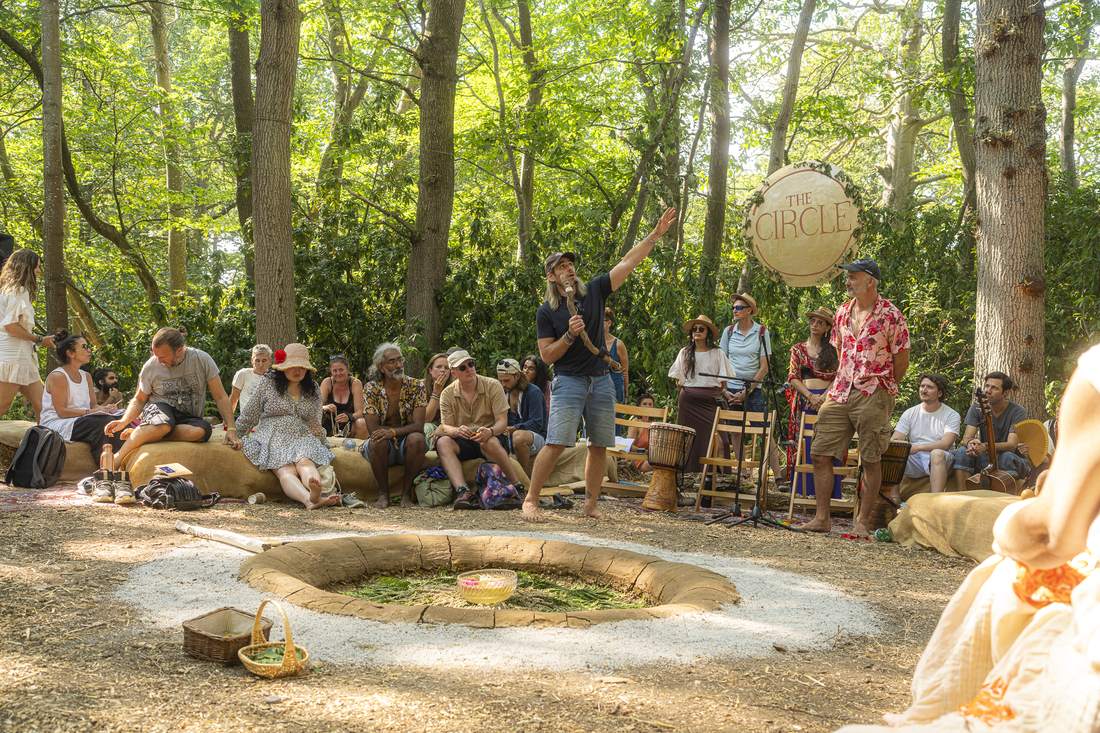
From the circle
The recording of this part ends mid-sentence, as the speaker turned to tax.
The closing: Joshua Dugdale
Closing the circle, standing together around the water, as it began.
Good ancestors
Josh named what the afternoon had been: agency in action. If his descendants in two hundred years were doing something like this, he would be glad. Humans have extraordinary, unique capacities, he said, and we need to remember them. He invited everyone to write a sentence about what they felt, to be placed at the altar and buried at the closing ceremony, and to get in touch with the Centre for Human Agency.
I would like to thank our ancestors, my ancestors, our more than human ancestors, for every action and decision and choice that they made which has formed us. I hope that all of us are able to take that responsibility forward, so that our descendants can look back at us and feel happy and grateful for the way that we behaved.
Joshua Dugdale
Gracie and Estelle closed as they had opened. They asked everyone to stand, to bring offerings of rose petals and bay leaves to the altar, and to send their love and prayers into the water. Then came drumming and song, so the body could take in what the mind had heard. “Let’s start learning the ways of the waters.”
The threads that ran through
Across three hours and many voices, the same few ideas kept returning. Each thread shows who carried it.
Agency is something we do together
Pushing back against the story of AI told by a few is shared, democratic work, practised in circles like this one. The circle itself was agency in action.
Alex Thomas, Keyun Ruan, Carl Hayden Smith, Matt, Joshua DugdaleIntelligence is only one part of us
Being clever at reaching goals is different from feeling, from wisdom, and from relationship. A flower teaches innocence, purity and beauty. A simulated rainstorm makes nothing wet.
Jacob Burda, Alex Thomas, Phoebe Tickell, KurikindiPower without accountability
An AI cannot answer for what it does, and the people who build it hold great power. The harm is often hidden inside decisions about mortgages, jobs and arrests. Watch for “power over” posing as “power to.”
Robbie Stamp, Sarah Andrew, Elaine Kasket, Phoebe TickellMind and Body
What we most need arrives slowly, through breath, the body and our bond with the earth. Many speakers began by greeting the land, and the circle was held by drum, song and water.
Josh Schrei, Gracie and Estelle, Carl Hayden Smith, Shauna Blue Star NewcombThe long line
We stand in a chain of ancestors whose choices made us, and we are the ancestors of people we will never meet. Being a good ancestor means acting now for seven generations ahead.
Phoebe Tickell, Tushita Jha, Lucaram, Joshua DugdaleHold the paradox
Neither doom nor utopia helps. AI can bring patience to a struggling child and health advice to places without doctors, even as it erodes trust and concentrates power. We must hold both with care.
Robbie Stamp, Martijn, Carl Hayden Smith, Ali BeinerQuestions to carry
The circle did not end with answers. These are questions from the speakers that anyone can bring into daily life.
Whenever I use AI, is this giving me more agency, or am I giving my agency away?
Carl Hayden SmithIf bees did AI research, would they build a queen to rule them, or a smarter hive?
Tushita JhaIf nobody can flourish on their own, who am I flourishing with?
after Keyun RuanWhen the agent in my pocket has solved me, what am I going to do?
Alex ThomasIs this adding to my power to do things, or to someone’s power over others?
Robbie StampIf a system makes a decision about me that feels wrong, will I ask why?
Sarah AndrewWhat is the fire in my own mind that needs to be put out?
KurikindiWhat do I most profoundly love, and will this help it flourish?
Natalie NahaiWill my descendants look back at how I behaved and feel gratitude?
Joshua Dugdale
Be the ancestor your descendants would thank
The Centre for Human Agency is a community in formation, founded by Joshua Dugdale and Professor Carl Hayden Smith. It explores how to protect and strengthen human agency as AI grows more capable, and what it means to steward this moment well. They are looking for founding members, advisors and collaborators. If these questions stay with you, you are invited to help shape what it becomes.
This record was drawn from audio of the Circle Stage session at Medicine Festival, Wasing Estate. It is shaped for reading, with quotes lightly cleaned of pauses and repeats. Names are given as announced in the circle. A few short passages were not captured, and these are marked. With thanks to every voice in the circle, to the land at Wasing, and to the ancestors and descendants we spoke for.
Get involved
Let’s build this together
We are looking for founding members, advisors and collaborators who think seriously about human agency, long-term civilisational risk, and what it means to be responsible stewards of this moment. Whether you work in AI, policy, ethics, law or the arts, or simply care deeply about our collective future, we would love to hear from you.